
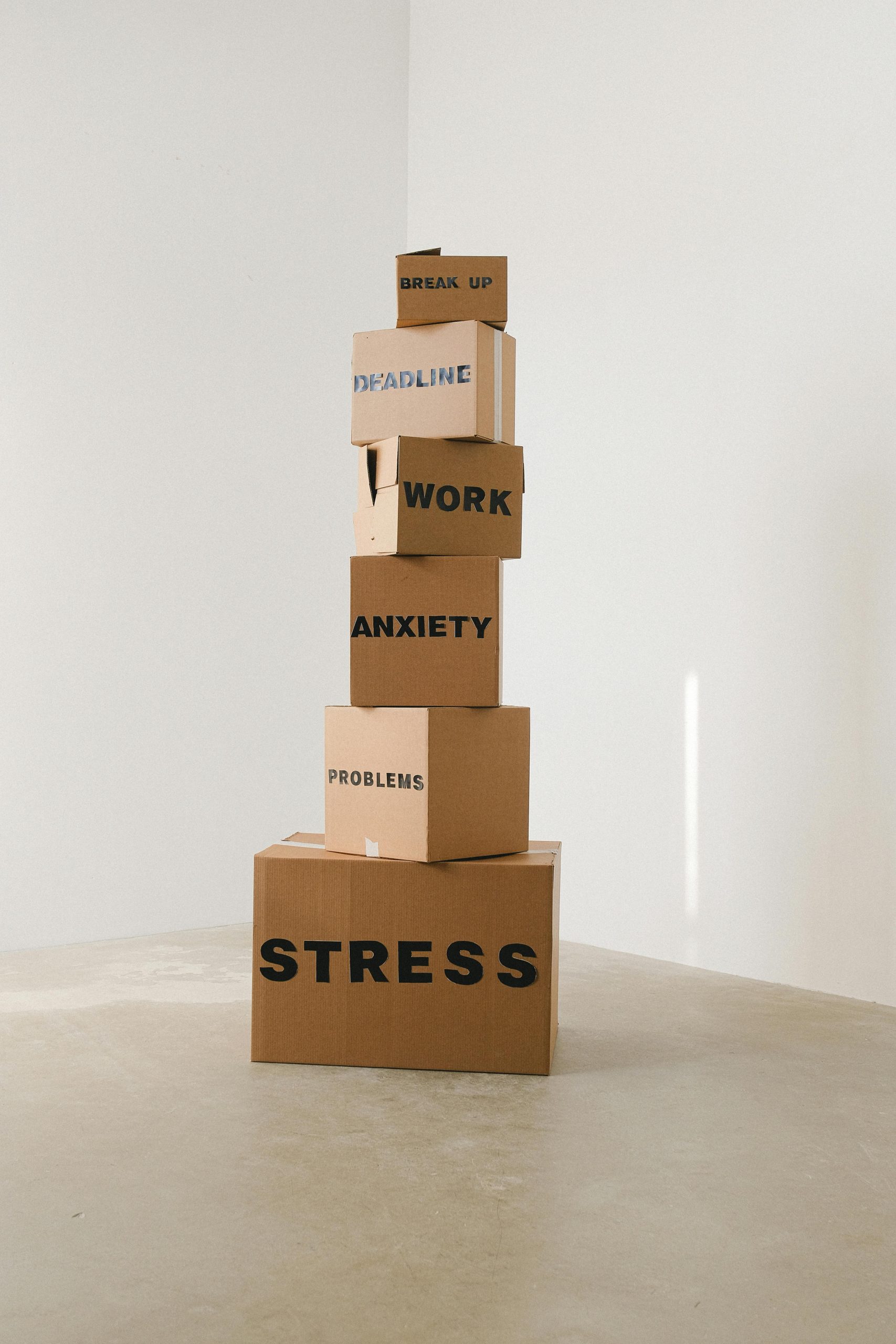
STRESS MANAGEMENT
- Overview
- Assessment
- Fight or flight response
COPING - Relaxation techniques
- Coping strategies
- Coping skills
- Self-care ideas
- Social support
- Positive self-talk
COGNITIVE INTERVENTIONS - Stress-inducing attitudes inventory
- Unhelpful thinking styles
- Untwisting thinking
- Reality vs. expectations
- STOPP technique
PRACTICAL INTERVENTIONS - Problem solving
- Time management tips
- Goal breakdown
- Stress management plan
STRESS MANAGEMENT
PACKAGE
Stress Management Tips
- Identify your stressors and determine if there are aspects within your control that you can manage better. Some stressors, like job-related deadlines, may be unavoidable unless you change jobs. However, you may be able to control certain factors, such as ensuring you take a short lunch break each day or going to bed earlier to have more energy during the day.
- Incorporate regular exercise into your life. Besides contributing to a healthy, balanced lifestyle and increasing your energy levels, many people find that working out at the gym or playing sports helps them unwind.
- Ensure that you eat well and get sufficient sleep.
- Take time out for family, friends, and recreational activities. While most people understand the importance of these aspects, not everyone makes time for them. If you struggle to set aside time, consider scheduling one evening a week to meet with friends or enjoy a hobby, or dedicate one day of the weekend to relaxing at home.
- Utilize problem-solving techniques to clarify issues, brainstorm potential solutions, and then choose an option to implement after weighing the pros and cons. Refer to the handout Problem Solving for further details.
- Learn calming techniques such as controlled breathing and progressive muscle relaxation to train your mind and body to relax. These techniques require practice but can be highly effective when used regularly. See the handouts Calming Techniques and Progressive Muscle Relaxation for guidance.
- Consider consulting a professional about assertiveness training and communication skills to help you handle challenging situations more effectively, thereby reducing stress. Refer to the handout Assertive Communication for more information.
- Lastly, assess whether negative thinking is contributing to your stress. Negative thinking can lead to excessive worrying, increased stress, and decreased motivation to take positive action. See the handouts Thinking & Feeling, Analyzing Your Thinking, and Changing Your Thinking for further guidance.
Stress and Stressors
Stress is a natural part of life, experienced by everyone from time to time. However, some individuals experience frequent or severe stress that significantly impacts their quality of life. Stress can stem from a wide range of sources (stressors), including:
- Relationships with others
- Work-related challenges
- Academic demands
- Coping with illness
- Major life changes, such as marriage, retirement, or divorce
- Daily responsibilities and tasks
- Positive events, such as planning a holiday or party
- Managing multiple roles or responsibilities simultaneously
Some people are aware of their stress triggers and can take proactive steps to either prevent or manage stress effectively. Others may struggle with stress management, making it essential to identify key stressors. If you frequently experience stress, take time to reflect on what typically triggers it for you.
Symptoms of Stress
Many individuals do not recognize their stress until they begin experiencing symptoms, which may include:
- Irritability or mood swings
- Disrupted sleep patterns
- Excessive worrying or anxiety
- Neck and back pain
- Frequent headaches (ranging from minor to migraines)
- Upset stomach
- Elevated blood pressure
- Changes in appetite
- Skin breakouts or rashes
- Chest pain
- Worsening of existing physical conditions
- Increased susceptibility to colds and slower recovery times
These symptoms can negatively impact quality of life, work performance, and relationships. If stress is affecting you significantly, consider using some of the strategies mentioned or seek professional help for additional support.
Stress Management Techniques
Stress can be managed using various techniques, including:
- Social support
- Emotional management skills
- Maintaining a healthy life balance
- Attending to basic needs
Social Support Talking to others about your problems can ease stress by releasing hormones that help reduce anxiety. Even if your support system cannot solve the problem, simply sharing your thoughts can be beneficial.
List three people you can turn to for support: 1. 2. 3.
Emotional Management Stress can trigger emotions such as anxiety, self-doubt, and anger. Ignoring these emotions may worsen the stressor. Emotional management does not eliminate emotions but helps in dealing with them healthily.
- Identify any habits that worsen your emotional response to stress.
- List two ways you have successfully handled unpleasant emotions in the past: 1. 2.
Life Balance An imbalanced lifestyle can exacerbate stress. Evaluate your focus on different life areas and identify areas needing more attention.
Rate each area from 1 (low attention) to 5 (high attention):
- Career __
- Family __
- Fun/Recreation __
- Spirituality __
- Socializing __
- Intimate Relationships __
- Education __
- Other __
Are there any areas where you would like to devote more attention?
Basic Needs During high-stress periods, people often neglect basic needs such as sleep, diet, exercise, and self-care. Neglecting these needs can worsen stress and impact mental and physical health.
Circle any basic needs you tend to neglect during stress:
- Sleep
- Healthy diet
- Exercise
- Medical adherence (medications, appointments, etc.)
- Personal hygiene
- Social/love needs
- Managing addictions
- Other: _____
Describe steps you can take to protect your basic needs during stressful periods.
Relaxation Techniques
Deep Breathing
- Breathe in slowly for at least 5 seconds.
- Hold your breath for 5 to 10 seconds.
- Exhale slowly for 5 to 10 seconds, as if breathing through a straw.
- Repeat until you feel calmer.
Imagery
- Find a quiet place.
- Imagine a calming location (e.g., beach, mountain, or peaceful home setting).
- Visualize details using all five senses to create a realistic mental image.
Progressive Muscle Relaxation
- Sit or lie down in a quiet space.
- Tense each muscle group for 5 seconds, then release.
- Move progressively from your toes to your head, relaxing each area.
Coping Activities
Engaging in positive activities can help reduce stress. Consider:
- Exercise (running, walking, yoga)
- Writing (journal, poetry, stories)
- Spending time with pets
- Watching a favorite TV show or movie
- Engaging in creative activities (drawing, painting, music)
- Meditation or prayer
- Reading a book
- Spending time with supportive friends or family
- Practicing mindfulness or relaxation exercises
- Completing tasks you’ve been procrastinating
- Seeking professional support if necessary
Stop, and breathe. I can do this.
- This will pass.
- I can be anxious, angry, or sad and still deal with this.
- I have done this before, and I can do it again.
- This feels bad, but it’s a normal body reaction—it will pass.
- This feels bad, and feelings are very often misleading.
- These are just feelings; they will go away.
- This won’t last forever.
- Short-term pain for long-term gain.
- I can feel bad and still choose to take a new and healthy direction.
- I don’t need to rush; I can take things slowly.
- I have survived before, and I will survive now.
- I feel this way because of my past experiences, but I am safe right now.
- It’s okay to feel this way; it’s a normal reaction.
- Right now, I am not in danger. Right now, I’m safe.
- My mind is not always my friend.
- Thoughts are just thoughts—they’re not necessarily true or factual.
- This is difficult and uncomfortable, but it’s only temporary.
- I can use my coping skills and get through this.
- I can learn from this, and it will be easier next time.
- Keep calm and carry on.
Coping Thought / Positive Statement
Write down a coping thought or positive statement for each difficult or distressing situation—something you can tell yourself that will help you get through. Write them down on a piece of card and carry it in your pocket or handbag to remind yourself when needed.
Identifying Stress-Inducing Attitudes
Which of the following do you find yourself dealing with? Be honest! Choose the columns that best describe your tendency to engage in the attitudes and beliefs below, and select several to discuss at your next session.
| Attitude/Belief | Not Much | Sometimes | Frequently |
|---|---|---|---|
| Rigidity | ☐ | ☐ | ☐ |
| Perfectionism | ☐ | ☐ | ☐ |
| Intolerance for myself and others | ☐ | ☐ | ☐ |
| Compulsion to overwork | ☐ | ☐ | ☐ |
| Messages of unworthiness (e.g., “I don’t deserve __”) | ☐ | ☐ | ☐ |
| Obsession with envy | ☐ | ☐ | ☐ |
| Feelings of incompetence | ☐ | ☐ | ☐ |
| Phobias | ☐ | ☐ | ☐ |
| Fear of commitment | ☐ | ☐ | ☐ |
| Non-acceptance of myself | ☐ | ☐ | ☐ |
| Non-acceptance of others | ☐ | ☐ | ☐ |
| Bitterness | ☐ | ☐ | ☐ |
| Unprocessed regret | ☐ | ☐ | ☐ |
| Sense that the world “should” be a certain way | ☐ | ☐ | ☐ |
| Distorted sense of control (either too much or too little) | ☐ | ☐ | ☐ |
| Lack of perspective | ☐ | ☐ | ☐ |
| Placing conditions on my happiness | ☐ | ☐ | ☐ |
| Lack of gratitude | ☐ | ☐ | ☐ |
Unhelpful Thinking Styles
- All-or-Nothing Thinking: Viewing situations in black and white (e.g., “If I’m not perfect, I’ve failed.”).
- Mental Filter: Focusing only on the negatives and ignoring the positives.
- Jumping to Conclusions: Assuming we know what others are thinking (mind reading) or predicting the future (fortune telling).
- Emotional Reasoning: Believing something is true just because you feel it is (e.g., “I feel embarrassed, so I must be an idiot.”).
- Labeling: Assigning extreme labels to yourself or others (e.g., “I’m a loser.”).
- Overgeneralization: Making broad conclusions based on a single event (e.g., “Everything always goes wrong for me.”).
- Disqualifying the Positive: Ignoring the good things that happen (e.g., “That doesn’t count.”).
- Magnification & Minimization: Blowing negatives out of proportion (catastrophizing) or minimizing positives.
- Should/Must Statements: Holding unrealistic standards (e.g., “I should always be successful.”).
- Personalization: Blaming yourself for things beyond your control or blaming others for your own mistakes.
Ten Ways to Untwist Your Thinking
- Counter the Distortion: Write down your negative thoughts to identify cognitive distortions.
- Examine the Evidence: Look for real evidence that supports or contradicts your thought.
- The Double-Standard Method: Talk to yourself as you would a friend.
- The Experimental Technique: Test your negative thoughts (e.g., if you think you’re weak, try lifting weights).
- Thinking in Shades of Gray: Rate your performance on a scale rather than seeing it as a total failure or success.
- The Survey Method: Ask others if they have similar thoughts or feelings to gain perspective.
- Define Terms: Question labels (e.g., “What does it really mean to be a ‘failure’?”).
- The Semantic Method: Replace negative words with gentler, more realistic language.
- Re-attribution: Consider all factors contributing to a situation rather than blaming yourself entirely.
- Cost-Benefit Analysis: Weigh the pros and cons of your thoughts and behaviors.
Reality vs. Expectations
Happiness = Reality ÷ Expectations
When reality is lower than our expectations, we feel unhappy. To create balance:
Step 1 – Improve My Reality
- Increase my coping skills (e.g., mindfulness, problem-solving).
- Identify what I can change and take action.
- Accept things as they are if change isn’t possible.
Step 2 – Lower My Expectations
- Examine my expectations of myself, others, and life.
- Consider alternative viewpoints.
- Recognize when I’m demanding too much from myself.
STOPP: A Technique for Managing Stress
S – Stop: Step back from the situation.
T – Take a breath: Breathe deeply and slowly.
O – Observe: Notice your thoughts, emotions, and physical sensations.
P – Pull back: Look at the situation objectively. Is it fact or opinion? What advice would you give a friend?
P – Practice what works: Take action that aligns with your values and long-term goals.
Stress Management Plan
| Main Stressors | My Stress Reactions | Coping Strategies | Support Persons | Deadlines for Implementation | Comments |
|---|---|---|---|---|---|
| Example: Divorce | Digestive issues, low self-esteem, feeling overwhelmed | Meditation, therapy, social activities | Friends, therapist | Start therapy next week | Reassess in two months |